How Can OEMs Choose the Right Quarter-Turn Electric Actuator?
News Details
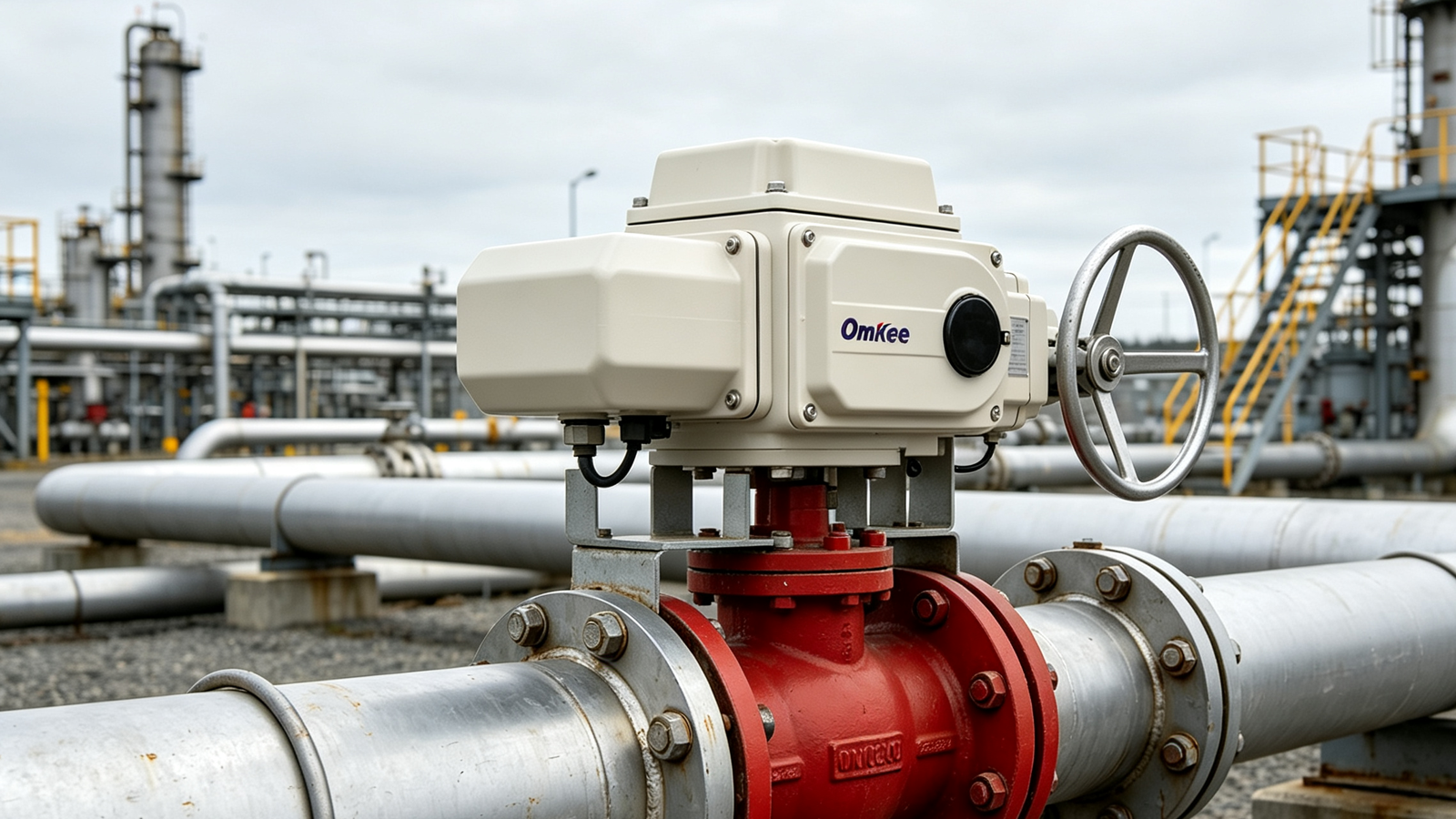
For OEMs and system integrators, selecting a quarter turnelectric actuator is not simply a matter of choosing the highest torque model. The actuator must match the valve, control system, working cycle, installation space, and site conditions.
A good selection process starts with the application. Then, each technical requirement can be checked one by one.
OMKEE develops electric valve actuators and automated valve solutions for industrial applications, including petroleum, power, and water treatment. Its range covers compact models, high-torque actuators, IP68 products, and explosion-proof solutions.
1. Start With the Valve Torque
The first question is simple: How much torque does the valve need?
Ball valves, butterfly valves, and plug valves can have very different torque requirements. The required torque can also change with pressure, temperature, medium, and valve design.
Before choosing an actuator, obtain the valve manufacturer's torque data. Check at least:
-
Breakaway torque
-
Running torque
-
Seating torque
-
Maximum operating torque
-
Required safety margin
The actuator should have enough output torque for the full valve cycle. However, choosing an oversized actuator without a reason can increase cost, power use, and physical size.
For OEM projects, it is better to define the valve torque first and then match the actuator.
2. Check the Mounting Interface
The actuator must physically connect to the valve.
For many quarter-turn valve systems, the mounting interface follows standardized dimensions such as ISO 5211. Check the:
-
Mounting flange
-
Bolt pattern
-
Drive shape
-
Drive dimensions
-
Stem engagement
-
Adapter requirements
This is especially important when the actuator and valve come from different suppliers.
A correct torque rating does not guarantee a correct mechanical fit. Therefore, the mounting dimensions should be confirmed before an order is placed.
3. Consider the Available Installation Space
Space can be a major issue in packaged equipment.
An OEM may need to install the actuator inside a cabinet, skid, water treatment system, HVAC unit, or automated production line. In these cases, overall dimensions can be just as important as torque.
A compact electric actuator can be useful when space is limited.
When comparing models, check:
-
Overall length
-
Overall height
-
Width
-
Mounting clearance
-
Cable entry position
-
Manual override position
-
Valve and actuator alignment
OMKEE describes its actuator range as including compact structures designed for convenient installation.
4. What Does Duty Cycle Mean?
Duty cycle describes how much operating time an actuator is designed to handle within a given work pattern.
This matters because an actuator motor generates heat during operation. If the actuator is opened and closed too often, heat can build up.
For example, an actuator used for an occasional isolation valve may have very different requirements from one used repeatedly in an automated process.
Before selecting a model, determine:
-
Number of cycles per hour
-
Operating time per cycle
-
Continuous or intermittent operation
-
Required rest time
-
Ambient temperature
-
Valve torque during operation
Do not assume that a higher torque rating means the actuator can handle more cycles. Torque and duty cycle are separate specifications.
5. How Important Is Open Close Time?
Open close time is another key parameter for system integrators.
For a quarter-turn valve, this normally refers to the time needed to move through the specified valve angle, often 90°.
The required speed depends on the process. A water system may accept a slower movement, while a fast-response process may need a shorter operating time.
For example, OMKEE's OMK-05F lists a standard 20-second operating time at 50 Nm, while optional configurations include faster or slower combinations depending on the selected torque and power version.
When selecting an actuator, therefore, compare torque and open close time together rather than looking at speed alone.
6. Select the Correct Power Supply
Next, check the electrical supply available in the equipment.
Common options can include:
-
24 V DC
-
24 V AC
-
110 V AC
-
220 V AC
-
380 V AC
The correct voltage depends on the system design.
For example, OMKEE's OMK-05F is available in several power configurations, including DC24V, AC24V, AC110V, AC220V, and AC380V versions.
For OEMs, matching the actuator to the existing power system can simplify wiring and reduce the need for additional electrical components.
7. Choose the Right Control Method
The actuator also needs to communicate with the control system.
Depending on the application, you may need:
-
Open/close control
-
Passive position feedback
-
Resistance feedback
-
4–20 mA feedback
-
Modulating control
-
Local control
-
Remote control
For simple isolation valves, open/close control may be enough. However, process systems that need position monitoring or flow adjustment may require feedback or modulating functions.
OMKEE offers actuator configurations with different feedback and control options. For example, its OMK-05F includes a 4–20 mA position transmitter.
8. Check Environmental Protection
The operating environment should be considered before the final selection.
Ask:
-
Is the actuator indoors or outdoors?
-
Will it contact rain or water?
-
Is dust present?
-
Is the ambient temperature high or low?
-
Is the installation near chemicals?
-
Is the location potentially hazardous?
For outdoor and wet environments, an appropriate IP rating is important.
For hazardous areas, a standard actuator may not be suitable. Instead, the system may require a certified explosion-proof actuator designed for the specific hazardous environment.
OMKEE offers IP68 and explosion-proof actuator options for demanding industrial applications.
9. Do Not Forget Manual Override
A manual override can be useful when electrical power is unavailable.
For OEM equipment, consider whether operators need to move the valve manually during:
-
Commissioning
-
Maintenance
-
Power failure
-
Troubleshooting
-
Emergency service
The manual operating method should be easy to access without creating interference with nearby equipment.
10. Build a Simple Selection Checklist
Before approving an actuator, OEMs and system integrators can use this checklist:
| Item | What to Confirm |
|---|---|
| Valve type | Ball, butterfly, plug, etc. |
| Torque | Required valve torque + safety margin |
| Mounting | Flange and drive dimensions |
| Rotation | Required angle |
| Speed | Open close time |
| Duty cycle | Cycles and operating frequency |
| Power | Voltage and electrical supply |
| Control | On/off or modulating |
| Feedback | Required position signal |
| Protection | IP rating or hazardous-area requirement |
| Space | Actuator and installation dimensions |
| Manual override | Required or optional |
| Environment | Temperature, water, dust, chemicals |
This checklist helps prevent common selection errors before the actuator reaches the production line.
How Can OEMs Reduce Actuator Selection Problems?
The best approach is to create a complete actuator specification before contacting suppliers.
Instead of asking only for an actuator with a certain torque, provide the valve type, torque, rotation, duty cycle, open close time, power supply, control method, mounting interface, environment, and available installation space.
Then ask the supplier to confirm the proposed model against every requirement.
This is especially useful for OEM projects because the same actuator may need to be installed across hundreds or thousands of machines. A small specification error can become a large production issue.
Conclusion
Choosing a quarter turn electric actuator requires more than matching torque.
OEMs and system integrators should check the complete application, including valve torque, mounting, actuator size, duty cycle, open close time, power supply, control signals, feedback, environmental protection, and manual operation.
A compact electric actuator may be the right choice for space-limited equipment, while a larger or explosion-proof model may be better for demanding industrial environments.
OMKEE provides multiple electric actuator configurations for valve automation, including compact, high-torque, IP68, feedback, and explosion-proof options.
By checking each requirement before ordering, OEMs and system integrators can create valve automation systems that are easier to install, control, maintain, and scale.


