Electric Actuator: Types, Uses, and Benefits for Industrial Control
News Details
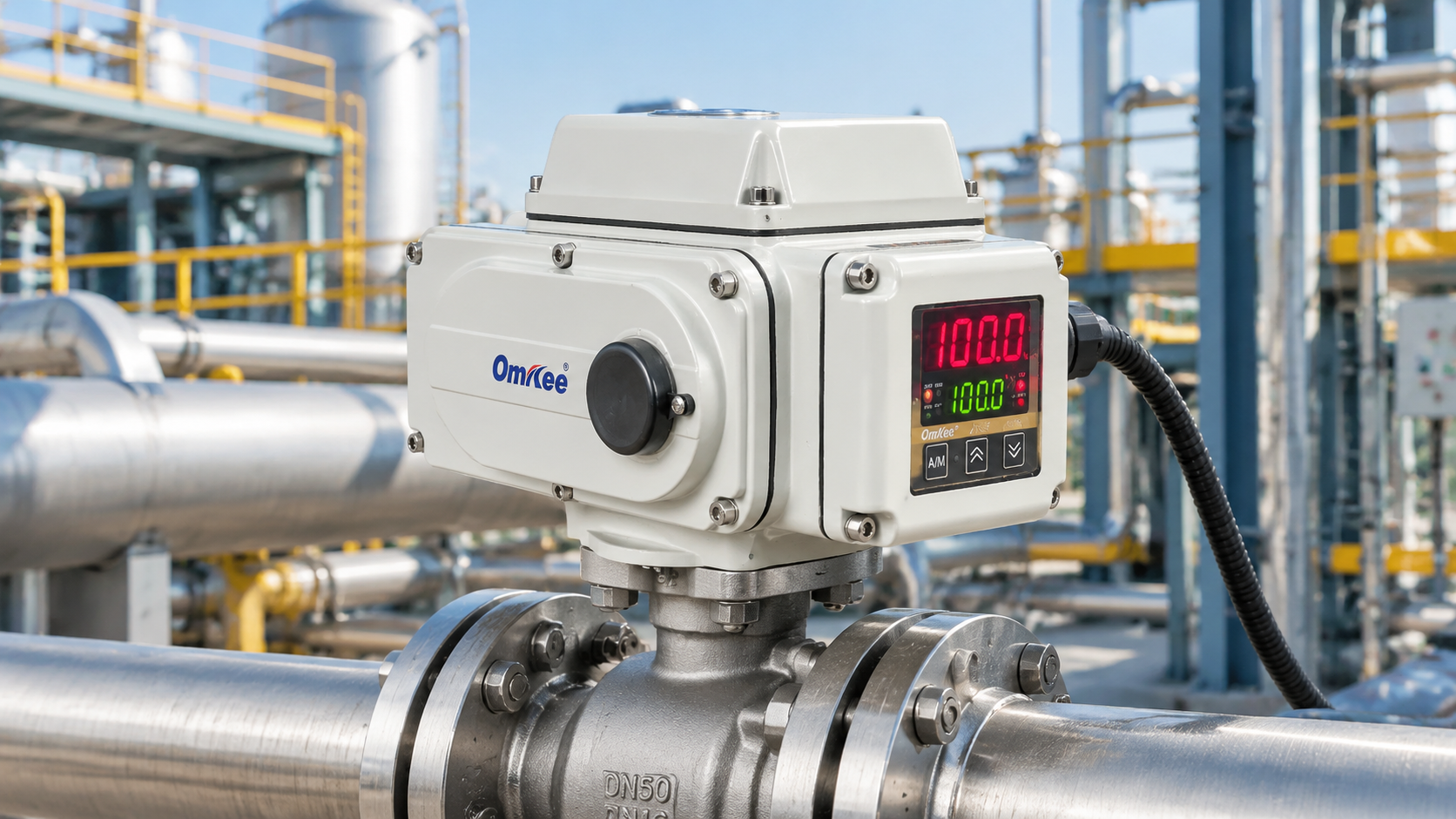 Electric actuators use electrical power to control the movement of valves or machinery. They can open or close valves, adjust their position, or regulate fluid flow, making them essential in industrial automation.
Electric actuators are widely used today in water treatment, power plants, HVAC systems, chemical processing, and other industries. They can also integrate with control systems to enable remote operation and reduce manual labor.
In this guide, we explain how electric actuators work, compare common types, and explore how OMKEE provides industrial valve control solutions.
What is an Electric Actuator?
actuAn electricator is a device that converts electrical energy into mechanical motion. It typically consists of an actuator motor, a gear system, and a control unit, which work together to move a valve or other equipment.
There are two common motion types: rotary and linear.
A rotary actuator rotates a shaft through a specific angle. For example, a quarter-turn electric actuator can turn a ball valve approximately 90 degrees, making it ideal for many automated valve systems.
In contrast, a linear actuator produces motion along a straight line and is often used to push, pull, lift, or position loads.
Therefore, the appropriate actuator depends on the motion, force, and control requirements of your equipment.
What are Linear Actuators?
What are linear actuators and how do they work?
Linear actuators move objects in a straight line rather than rotating them. An electric linear actuator typically uses a motor and a screw mechanism to convert rotary motion into linear movement.
When the motor runs, the screw drives a rod or carriage forward or backward. This motion can then open a damper, adjust a machine component, lift a platform, or position industrial equipment.
Common applications include:
-
Factory automation and production equipment
-
Adjustable worktables and lifting systems
-
Machine positioning and material handling
-
Dampers and other linear control devices
However, linear actuators differ from quarter-turn valve actuators. Ball valves and butterfly valves typically require rotary motion, making a rotary electric actuator the better choice for these valves.
Why Use Electric Linear Actuators?
There are several reasons to choose an electric linear actuator for suitable applications.
First, it offers precise motion. With the right control system, the actuator can move to a set position instead of relying on manual adjustment.
Second, it integrates easily into automated equipment. Many models are compatible with electrical controls, sensors, and programmable logic controllers (PLCs).
Third, an electric linear actuator does not require a compressed air supply, simplifying installation when electricity is already available.
Finally, it supports repeatable operation, which is useful when a machine must perform the same motion repeatedly throughout the day.
Still, proper selection is crucial. Check the required force, stroke length, operating speed, duty cycle, and working environment before choosing a model.
How Do Electric Actuated Ball Valves Work?
Electric actuated ball valves combine a ball valve with an electric actuator. Inside the valve, a ball with a bore controls the flow of liquid or gas, and the actuator rotates the ball to open or close the flow path.
When the control system sends a signal, the actuator motor drives the gears and valve stem, moving the ball to the desired position.
These valves are useful in water treatment, HVAC, industrial pipelines, and automated process systems. They also support remote operation, allowing operators to manage valves from a control room.
For example, OMKEE offers electric actuators and electric ball valve solutions for industrial flow control, including compact actuators, modulating models, and options designed for demanding environments.
When selecting electric actuated ball valves, consider the valve material, connection type, working pressure, media, required torque, power supply, and control mode. The valve and actuator must be properly matched for safe and reliable operation.
How to Choose the Right Actuator Motor
The actuator motor is a key component of an electric actuator, providing the power needed to move the valve or load. However, a motor with a higher power rating is not always the best choice.
Instead, consider these factors:
-
Output torque or force: Ensure the actuator can handle the valve or load under actual operating conditions.
-
Power supply: Verify whether the site requires DC or AC power and confirm the available voltage.
-
Control mode: Determine if you need simple on-off control or continuous position adjustment.
-
Feedback: Some systems require open/closed status signals, while others need continuous position data.
-
Environmental protection: Check the required protection rating, temperature range, and any hazardous area certification.
-
Operating frequency: Choose a model suitable for how often the actuator must start, stop, or adjust its position.
For valve applications, correct torque sizing is especially important. An undersized actuator may struggle to operate the valve, while an improperly matched control mode can lead to unstable performance or unnecessary wear.
OMKEE Electric Actuator Solutions for Industrial Applications
Wuhan OMEC Technology Co., Ltd. operates the OMKEE brand and specializes in electric valve actuators and industrial automation control systems. Its product range includes standard electric actuators, intelligent modulating models, and explosion-proof options.
For example, the OMK-05D electric actuator delivers a rated torque of 50 Nm and dual position feedback. It provides continuous resistance feedback as well as fully open/closed position signals, helping control systems monitor valve status.
For larger valves, the OMK-250E intelligent modulating electric actuator offers a rated output torque of 2,500 Nm, designed for applications requiring high torque and precise valve positioning.
These examples illustrate the importance of matching the actuator to the actual valve and process requirements, rather than selecting based on size alone.
Application Example: Valve Hall Cooling Systems
OMKEE has published a case study on electric actuators for valve hall cooling systems in power transmission facilities. These systems use cooling water to regulate the temperature of critical electrical equipment.
In such applications, reliable valve operation is essential. Poor control or actuator failure can compromise cooling performance, and water hammer can impose sudden stress on valves and their drive systems.
OMKEE's published solution describes automated valve equipment designed for demanding conditions, with attention to torque capacity, environmental protection, and precise control. Its product portfolio includes IP68-rated actuators and modulating models for suitable applications.
This case highlights an important principle: actuator selection should consider the entire system, including valve torque, water pressure fluctuations, temperature, control signals, and maintenance requirements.
Final Thoughts
Electric actuators can enhance valve control, support automation, and reduce manual operation. However, rotary actuators and electric linear actuators serve different purposes, so selecting the right motion type is crucial.
For automated pipelines, electric actuated ball valves provide convenient remote flow control, while linear actuators suit equipment requiring straight-line motion.
OMKEE offers a range of electric actuators and valve automation solutions for industrial applications. By evaluating your operating conditions and control requirements, you can select a system that meets your project's needs.
To explore available models, visit the OMKEE Electric Actuator range or contact the OMKEE team for application guidance.


